Quick answer
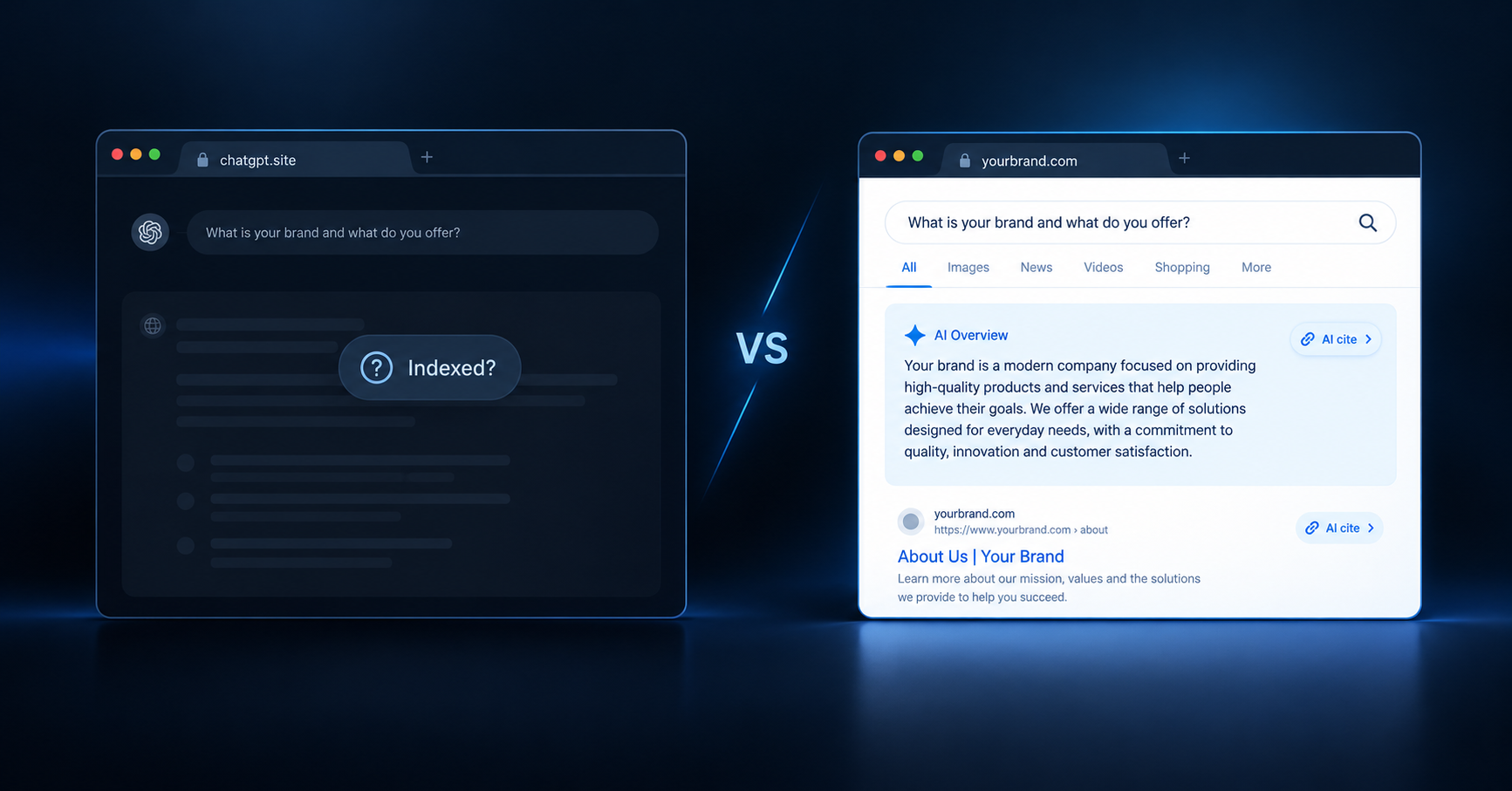
Google can find some public ChatGPT Sites — but OpenAI does not document indexing as a feature guarantee. Indexed on chatgpt.site ≠ brand SEO you own. A custom domain pointed at Sites still leaves OpenAI hosting. For search and AI citations under your entity, publish on a real host like GeminiLaunch, set title/meta/OG, then connect yourbrand.com.
Mental model
Three layers people mix up
Most “Sites SEO” confusion is three different questions wearing one label.
Layer 1
Hosted ≠ discoverable
A live HTTPS link means someone with the URL can open the page. It does not mean Google Search Console is connected, a sitemap exists, or robots and noindex signals are clear.
Layer 2
Indexed ≠ brand-owned
A chatgpt.site or Claude artifact URL can appear in results. That may help the vendor domain more than your company entity. Citations often follow trusted brand domains.
Layer 3
Custom domain on Sites ≠ your own hosting
Pointing yourbrand.com at ChatGPT Sites brands the address. OpenAI still hosts the Site. Leaving the product later is a different problem than changing a DNS sticker.
Key insight
Hosting answers “can someone open this?” SEO answers “can Google find it?” GEO and AEO ask “will AI engines cite you?” ChatGPT Sites can help the first. The second and third need ownership signals Sites was not built to sell.
Sources
What OpenAI documents — and what it doesn’t
OpenAI’s Sites docs explain create, save, deploy, share, and — where available — custom domains. The Sites Terms say OpenAI hosts published Sites on your behalf. You can still own the content while relying on their runtime.
What those docs do not clearly productize: Search Console workflows, sitemap guarantees, robots/noindex guidance, or “this Site will rank.” Independent write-ups have noted that crawlability is largely undocumented even while hosting is detailed.
For “does ChatGPT host at all?” see Does ChatGPT host websites?. This page is only about discovery.
Indexing reality in 2026
Public Sites have shown up in Google results for some testers. That proves crawlability is possible on at least some chatgpt.site deployments — not that every Site, plan, or region behaves the same.
Practical checks if you stay on Sites: confirm the Site is public, open it signed-out, inspect whether the live URL blocks bots or sends noindex, and search site:your-exact-url. Do not assume “Add domain” equals “submitted to Search Console on infrastructure you administer.”
Private Sites will not be a Google growth channel
Beta limits and sharing settings can change who can open the page
Vendor robots policy can change without your marketing team noticing
Thin demo pages may index and still never convert or build brand
GEO · AEO
Will AI engines cite your ChatGPT Site?
Generative engines (ChatGPT search, Perplexity, Google AI Overviews, Claude with retrieval) prefer clear, quotable answers on sources they trust. A public Sites URL can be retrieved. Building a durable brand citation usually needs more:
A domain that matches your company entity (yourbrand.com)
Self-contained sections engines can quote without fluff
Title, meta, and on-page structure you can edit without leaving the AI chat UI
Corroboration — mentions on other trusted sites, not only your own page
Pointing DNS at Sites improves the address people type. It does not automatically give you the same GEO stack as a host where you set title, meta, and Open Graph and keep the files when you leave.
Claude sidebar
Claude Artifacts can rank — that is not your brand either
People have watched Claude Artifact URLs appear for thin or niche queries — sometimes fast. Useful for demos. Misleading if you treat Anthropic’s domain as your marketing site.
Same three-layer test: the page is hosted, it might be indexed, and the brand equity largely sits on Claude’s infrastructure. When the page matters, copy it to a real host. Walkthrough: turn a Claude artifact into a real website.
Compare
Sites vs Claude vs a real host for SEO and GEO
Same page content. Three different ownership models for discovery.
| Option | AI citations | SEO control | Best for | |
|---|---|---|---|---|
| ChatGPT Sites | Possible if public — not documented as a guarantee | Vendor URL / OpenAI-hosted entity | Title/meta limited by Sites runtime | Demos and workspace apps |
| Claude Artifact | Sometimes ranks in thin niches | Anthropic-hosted page, not yourbrand.com | Artifact share settings; limited SEO tooling | Quick shareable demos |
| Real host (GeminiLaunch) | You control indexing signals on your URL | Entity you own — title, OG, domain, Search Console | Title, meta, OG image, republish, analytics | Brand SEO, GEO, client launches |
Decision
Which path should you pick?
Stay on Sites when
Internal workspace tools and private previews
Throwaway demos you will replace in a week
You already pay for Sites and do not care about Search Console yet
The page must use Sites-only runtime features you cannot rebuild as static HTML
Move to a real host when
You want Google, Bing, or AI answers to associate the page with your brand
You need Search Console, clear title/meta/OG, and a durable canonical URL
You are on Free/Go, or Sites/custom domains are unavailable
You want to leave OpenAI or Anthropic hosting without rewriting the business
Clients expect yourbrand.com — not a vendor subdomain
Free path
Move discovery to a host you control
For static landing pages and portfolios, this is usually enough. Full Sites apps with databases need a separate migration plan.
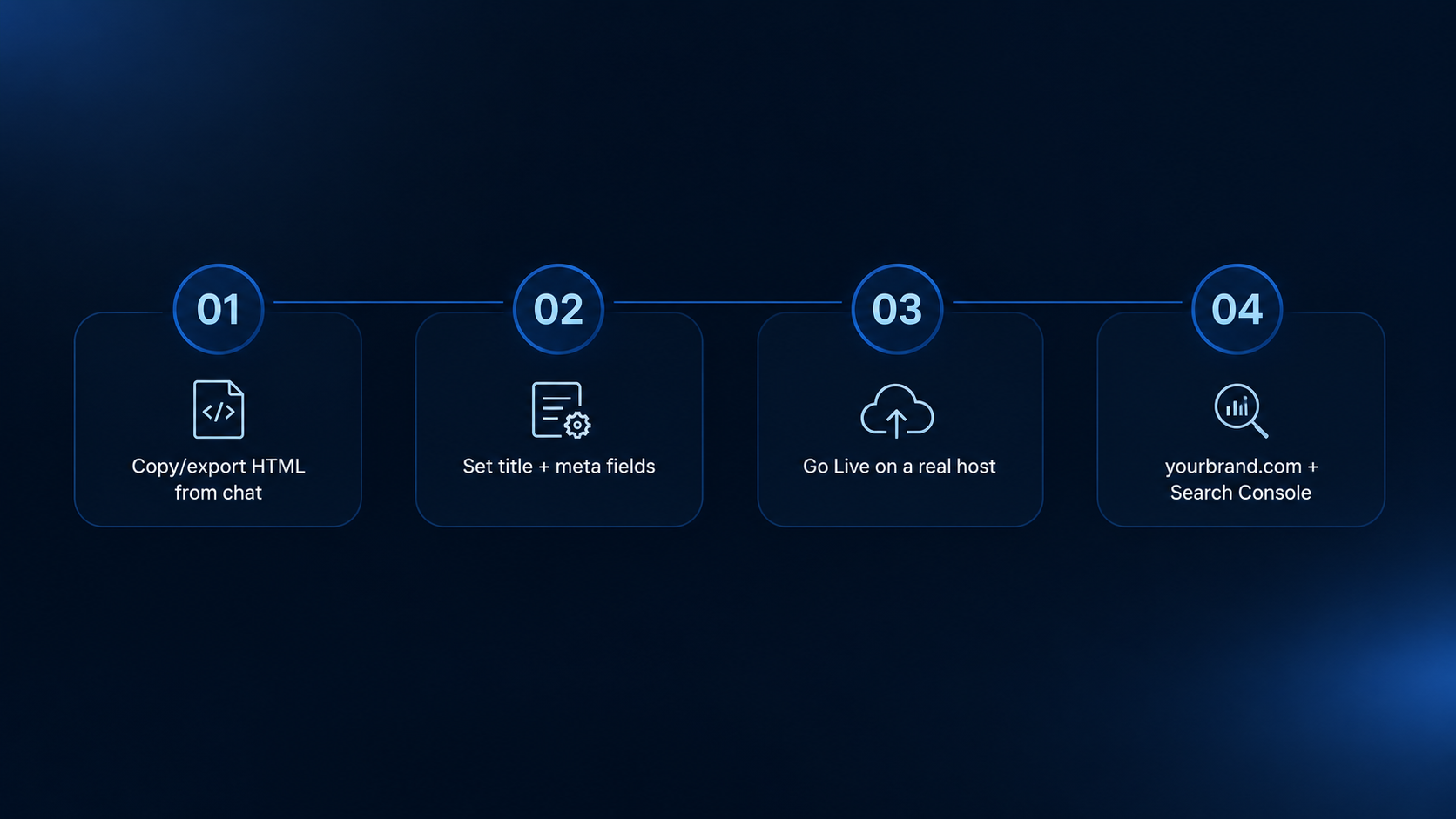
Get a portable copy of the page
Ask ChatGPT for a single self-contained HTML file (CSS/JS inline), or export a ZIP/folder with index.html. There is no documented one-click “download this Site as a portable project” for every Sites runtime — treat copy/export as the honest path for static marketing pages.
Tip: Prompt: "Export this as one complete HTML file, mobile-friendly, with a unique <title> and meta description. All CSS and JS inline."
Set SEO fields you can control
On a real host, set page title, meta description, and a 1200×630 social preview image before you push for rankings. That is how search snippets and link previews stay on-brand.
Tip: See our AI website SEO guide for title, meta, and Open Graph length targets.
Publish on a host you control
Paste HTML/React or upload a ZIP into GeminiLaunch and Go Live. You get a free HTTPS URL on *.geminilaunch.com — no GitHub. Anyone can open it without a ChatGPT account.
Tip: Validate mobile and title tags on the free URL before you change production DNS.
Connect yourbrand.com and claim Search Console
From GeminiLaunch Lite ($5/mo) connect 1 custom domain (Pro up to 5). Add the DNS record shown, wait for SSL, then add the property in Google Search Console and request indexing.
Tip: Custom domain on Sites brands OpenAI hosting. Custom domain on GeminiLaunch brands a host you can keep.
Domain DNS detail: ChatGPT custom domain guide. After launch, track views on AI website analytics.
Avoid these
Common mistakes
Assuming “Add domain” finished SEO
DNS makes the brand URL open. It does not invent a content strategy, backlinks, or Search Console verification on a host you control.
Confusing Claude Artifact rankings with brand SEO
Artifacts sometimes surface for thin queries. That is mostly Anthropic’s domain doing the ranking work — not a substitute for yourbrand.com authority.
Publishing privately and expecting Google
Sites start limited to owners/admins until you change access. Private Sites are not a public SEO play.
Skipping title and meta on the real host
Moving off Sites without setting a clear title and description wastes the migration. Snippets and AI citations need a clean, quotable chunk.
Related guide
Does ChatGPT host websites?
Hosting first — Sites vs Claude vs a real host.
Read the comparisonRelated guide
Title, meta & Open Graph
Set the SEO fields engines and social apps actually read.
Read the SEO guideFAQ
Frequently asked questions
Written for Google, ChatGPT, Perplexity, and classic search — short answers first.
Can Google find / index a ChatGPT Site?
Sometimes, if the Site is publicly reachable. Independent tests have seen chatgpt.site pages in Google. OpenAI’s Sites docs focus on create/host/share — they do not document indexing guarantees, robots policy, or SEO controls. Treat indexing as possible, not promised.
Does connecting a custom domain to ChatGPT Sites improve SEO?
A branded URL helps recognition and trust versus a random vendor subdomain. It does not automatically move you onto independent hosting, and it does not replace title, content quality, or links. For full SEO ownership, host where you control head tags and Search Console.
Is ChatGPT Sites SEO the same as owning your website SEO?
No. Sites SEO is “can this OpenAI-hosted page be found?” Brand SEO is “does search and AI associate this content with your company on a domain and host you control?” Those are different jobs.
Will ChatGPT or Perplexity cite my ChatGPT Site?
They may cite a public URL if it ranks or is retrieved. Citations often favor clear, self-contained answers on trusted brand domains. A vendor-hosted Site is weaker for building your entity than yourbrand.com with strong title/meta and corroborating mentions.
Do Claude Artifacts rank on Google?
Yes, in some niches people have reported Artifact URLs ranking quickly. That can be useful for demos — and risky if you thought you were building lasting brand equity on Anthropic’s domain. Move important pages to a real host when brand matters.
How do I make an AI-generated site SEO-ready on GeminiLaunch?
Publish the HTML/React or ZIP, set title + meta + Open Graph in SEO settings, share the free URL or connect yourbrand.com from Lite, then use Search Console. Optional: Pro analytics to see what traffic actually arrives.
Can I export a ChatGPT Site for SEO on another host?
There is no documented universal one-click export of every Sites runtime (especially apps with D1/R2). For static marketing pages, ask ChatGPT for complete HTML/assets or keep a local/Git source if you started from one, then publish on GeminiLaunch or another static host.
Should I use chatgpt.site or mybrand.com for GEO?
For generative engine optimization (GEO/AEO), prefer a domain that represents your brand entity. Vendor URLs can get cited; they rarely build the same durable brand association as yourbrand.com with clear answers, schema, and third-party mentions.
Does GeminiLaunch help with AI website SEO?
Yes for the hosting layer non-developers need: live HTTPS URL, title/meta/OG controls, custom domain from Lite, and optional Pro traffic analytics. Content quality and links still decide rankings — the host just stops blocking you.
ChatGPT Sites vs a real host — which for search in 2026?
Use Sites for fast demos inside ChatGPT. Use a real host when Google visibility, AI citations under your brand, Search Console, and long-term ownership matter. Many teams prototype on Sites, then paste or upload the static page to GeminiLaunch for launch.
Like this guide? Make GeminiLaunch a preferred source.
Get our hosting and deployment guides surfaced first in your Google results, AI Overviews, and Top Stories.
Put discovery on a URL you control
Paste or upload your AI page, set title and meta, publish free, then connect yourbrand.com when you are ready for Search Console and brand citations.